If you live in a Cumbernauld New Town flat — Kildrum, Seafar, Carbrain, Abronhill, parts of Greenfaulds — there's a reasonable chance your bathroom is still wearing its original 1970s outfit. The Avocado or Champagne suite, the patterned tile splash, the cold gable wall, the extractor that hasn't worked in five years. We strip out a lot of these. This guide is what we tell customers in the first five minutes of the home visit — the realistic options, the things that surprise people, and roughly what it costs.
The 1.9 m × 1.7 m Footprint
Almost every CDC-era Cumbernauld flat has the same internal bathroom: 1.9 metres long by 1.7 metres wide, give or take a few centimetres. Original layout was a small bath under the rear wall, a basin opposite the door, and a WC tucked into the corner. It works, but it feels cramped because every fixture is full-size and the walls are visually busy.
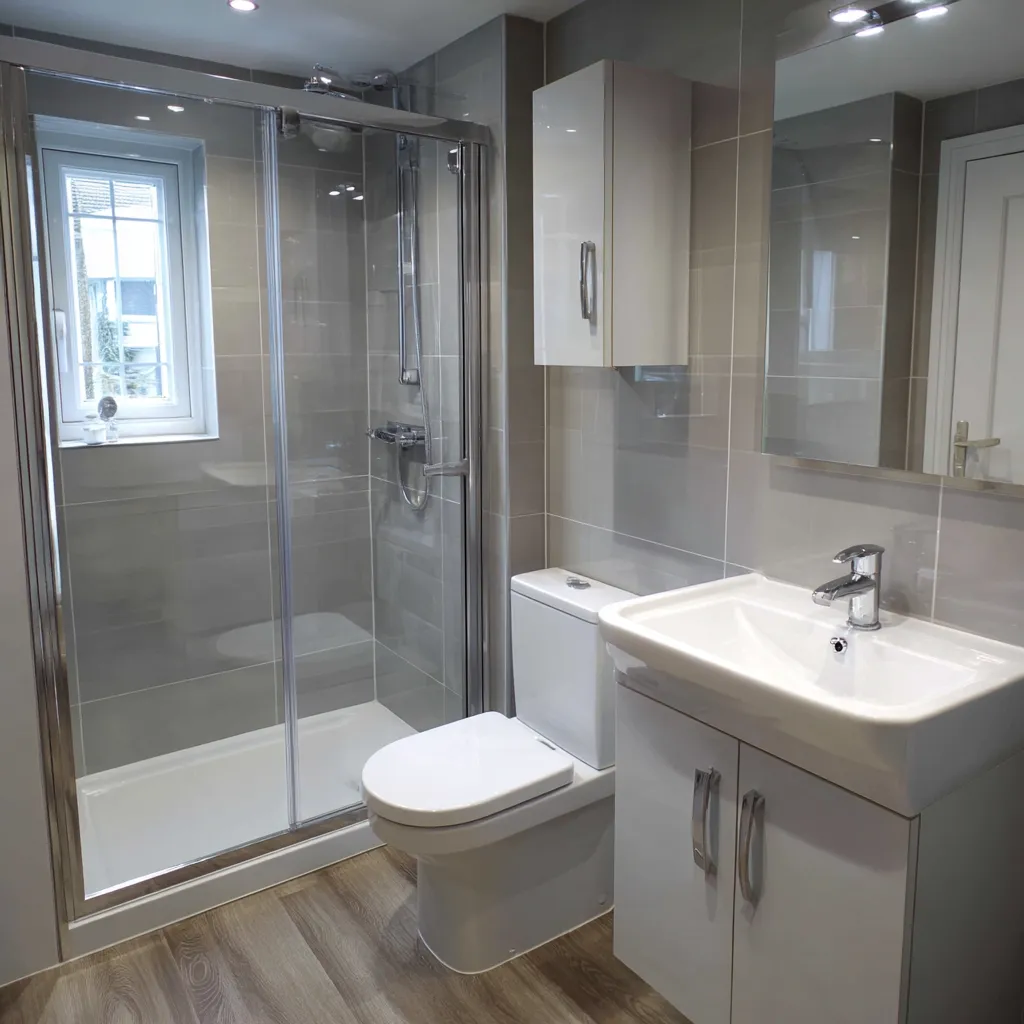
The single biggest space gain on a 1970s Kildrum or Seafar flat is replacing the bath with a walk-in shower. You free up roughly 0.4 m² of floor area, the room reads instantly bigger, and a frameless single-panel glass screen disappears visually in a way an enclosed cubicle never does. If you do want to keep a bath for resale or for kids, a P-shaped shower-bath with a hinged screen gets you 80% of the benefit in the same footprint.
The other footprint trick: wall-hung WC and basin. The original suite had everything on the floor with skirting, pipework boxing and dust traps. A wall-hung set lifts everything off the floor, gives you a continuous LVT surface to clean, and visually adds 15cm of perceived width. The framing sits behind the wet wall — it doesn't actually take any more space.
The Soil Stack Problem
In most CDC-era flats, the 110mm cast-iron soil stack runs vertically through the bathroom on the gable wall. It's exposed, it's bulky, and it's the reason the original bathroom couldn't lay out cleaner. Original 1970s practice was to box it in with hardboard and tile over the top — which works visually but eats 15–20cm of the room's width and creates a permanent dust trap.
Modern practice: re-route the stack inside the wet wall build-up. We strip the original boxing, fit a 50mm batten layer with insulation between, and finish with full-height wet wall over the top. The stack disappears completely, you get the full footprint back, and the cast-iron is encapsulated for sound deadening — a noticeable benefit if the upstairs flat flushes the WC at 6am every weekday.
Where the stack runs through to upstairs, we don't touch the section above the ceiling — that's a building-wide pipe and the rest of the close depends on it staying intact. We work around the existing pipe, not against it.
Cold Concrete Walls & Condensation
The original Cumbernauld system-built blocks have solid concrete external walls — no cavity, no insulation. The internal face is plaster on dabs, and behind the original tile-and-grout splash, that face stays cold all year. Combine with poor ventilation and you get exactly what most 1970s Cumbernauld bathrooms have: persistent grout mould along the splash, intermittent wall dampness, and a room that takes 20 minutes to warm up after a shower.
The fix is straightforward but non-negotiable: battened wet wall over a thin insulating layer. We fix 50×25 timber battens to the existing wall, fit 25mm PIR insulation between, and panel over with full-height wet wall. The internal face of the room is now warm to the touch, the panels can't grow mould (no grout, no porous surface, no cold bridging), and shower heat doesn't condense on the wall surface in the first place. It's the single biggest quality-of-life upgrade in any New Town flat refurb.
Replacing the Original Extractor
If the bathroom is inboard (no external window — common in the deck-access blocks), Scottish Building Standards require mechanical ventilation. The original 1970s extractor is almost always: undersized, slow, on a manual switch nobody uses, and ducted through a hole that's half-blocked with debris. Effective extract rate after 50 years: zero.
We replace with a humidity-sensing extractor sized for the room — typically 15 litres per second minimum, often 20 l/s for the inboard configurations. The fan runs automatically when humidity rises above a threshold and continues until it drops back. You get proper air changes during and after a shower, the wet wall stays dry, and the room doesn't feel boxed-in 20 minutes after use.
Three Layouts That Actually Work
Layout A — Shower-only (most popular)
1200 × 900mm walk-in shower at the rear wall, frameless single panel glass, wall-hung WC and basin opposite. Maximum perceived space, minimum cleaning. Suits most adult households where a bath isn't a daily requirement.
Layout B — P-shape shower-bath
1700 × 850/700mm P-shape shower-bath where the original bath sat, hinged glass screen at the head end, wall-hung basin and WC opposite. Keeps the bath for kids or resale; loses about 30% of the floor space gain compared with Layout A.
Layout C — Wet room conversion
Tank-and-tile the entire floor, no enclosure, gravity drain. Maximum accessibility, minimum visual obstruction. Less common in CDC-era flats because of the floor depth needed for the drain — usually requires the floor to come up. Adds £700–£1,000 to the build but worth it for accessibility-led refurbs.
What It Costs
For a typical Kildrum, Seafar, Abronhill or Carbrain flat refurb in 2026:
- Starter package — £3,699. Layout A or B, splash-zone wet wall, LVT floor, LED mirror, chrome towel rail. Solves the cosmetic problem but doesn't fully address cold walls.
- Premium package — £5,499. The most-fitted spec for New Town flats. Full-room wet wall over insulation, frameless walk-in, demister LED mirror, humidity-sensing extractor, frosty privacy glass, premium LVT. Solves all four problems.
- Luxury package — £7,995. Premium spec plus underfloor heating, wall-hung concealed-cistern WC, niche shelving, designer fixtures. Less common in CDC-era flats — the room genuinely doesn't need it — but available.
0% finance is available on any package — the £3,699 Starter works out at around £67/month with no deposit.
Related reading: Full pricing breakdown, wet room vs walk-in shower, our Kildrum bathroom fitting page, and our wet wall bathroom service.
Got a 1970s Cumbernauld flat you'd like quoted? Call 01236 801802 or request a free home visit online.