Once you've settled on a thermostatic valve, the next question is where it lives: on the wall where you can see it, or inside the wall where you can't. It's a genuine trade-off — and the brochure photography only ever argues one side of it.
What Concealed Actually Means
An exposed valve mounts on the finished wall surface: a horizontal bar or unit with the pipework rising visibly to the head. A concealed valve buries the mixer body in the wall build-up; all you see is a trim plate and controls, with the pipework routed invisibly to a fixed head above. Same internals, different placement — and a very different day when something needs attention.
The Case for Concealed
It isn't just vanity. A concealed valve gives you back real space in a small enclosure — no bar to catch a shoulder on in an 800 mm quadrant. It's easier to clean around (one flat plate versus pipework's shadow gaps), and it suits the flat, grout-free planes of a wet wall room, where surface pipework can look like an afterthought. In the compact rooms we fit across Cumbernauld, the space argument alone often settles it.
The Case for Exposed
Everything mechanical eventually needs service. An exposed valve swaps in under an hour, any brand, any plumber, no wall opened. A concealed valve's cartridge is serviceable through the trim plate if the brand still makes the cartridge — and that's the entire game. A defunct brand's concealed valve with a failed body means opening the wall.
Exposed also tolerates budget kit better: if a £90 exposed bar fails in year six, it's an annoyance. A £90 concealed valve failing in year six is a wall.
The Wet Wall Factor
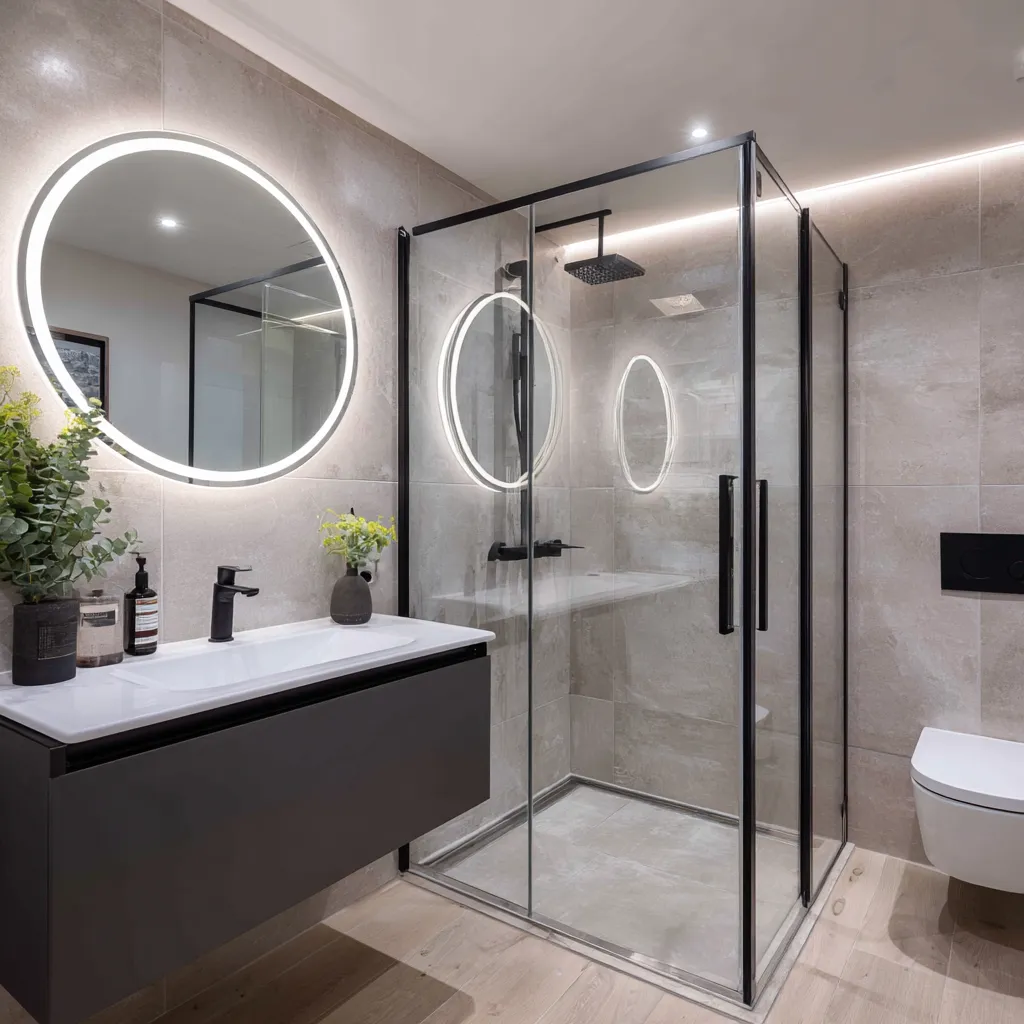
Wet wall panels change this calculation in your favour. Unlike a tiled wall — where opening up means smashing tiles you can't match — a properly fitted panel system can be opened at the valve zone and made good far less painfully. It's one of the quiet advantages in our panels vs tiles comparison, and it's part of why we're comfortable fitting concealed valves as often as we do.
Our Three Rules for Going Concealed
- Buy the valve like it's structural. Established brand, widely stocked cartridges, published spares. This is the one component where the cheap option is genuinely false economy.
- Twin controls, serviceable through the plate. Temperature and flow cartridges both replaceable from the front — ask the question before it goes in the wall.
- Pressure-test before the wall closes. Any fitter worth hiring tests the concealed pipework under pressure before a single panel goes over it. It's on our checklist for every fit — part of what the workmanship guarantee stands behind.
Related reading: Thermostatic vs manual valves, Wet wall panels vs tiles, Waterproofing and tanking explained, Our workmanship guarantee.
Not sure which way to go in your own bathroom? Call 01236 801802 — a five-minute conversation usually settles it.