Half our home visits start with a variant of the same question: "how long should this all last?" — asked about the room being replaced, and about the one we're quoting. The honest answer is that a bathroom isn't one product with one lifespan; it's a system of parts wearing at wildly different rates, and knowing which clock is ticking tells you what maintenance buys, and when replacement stops being premature.
A Dozen Clocks, One Room
Ranked fastest to slowest: silicone seals → extractor fans and flush internals → shower cartridges and door rollers → LVT and panel finishes → grout (where it exists) → sanitaryware → the pipework in the walls. The design insight hiding in that list: bathrooms fail from their joints and mechanisms, almost never from their big-ticket items — which is why our spec advice consistently spends on moving parts over badges.
The Consumables: 3–5 Years
Silicone sealant is the honest consumable nobody treats as one: flexing, shrinking and (once its fungicide leaches out) hosting the black speckle no scrubbing truly removes. A re-run every few years is normal servicing, not failure — ours includes free silicone re-runs in the first 12 months under the guarantee. Left failed, it graduates from cosmetic to structural: water behind the seal is how floors rot quietly, which is how a £40 job becomes a £900 one.
Moving Parts: 5–15 Years
- Extractor fans: motors and bearings tire within the decade — a fan that's gone quiet-and-useless is mould's best friend (the ventilation circuit)
- Flush and fill valves: the phantom-running cistern is a £10–15 part — if the part still exists, the spares argument again
- Thermostatic cartridges: quality valves serve 10–15 years then take a ten-minute cartridge swap; budget no-name valves fail sooner and irreplaceably (why it matters doubly when concealed)
- Door rollers, hinges, seats: the daily-cycled hardware — metal internals double the life of plastic ones
- Electric showers: hard-working appliances; Scottish soft water is kind to their heater cans (the soft water dividend), but a decade is honest service
Finishes: 10–20 Years
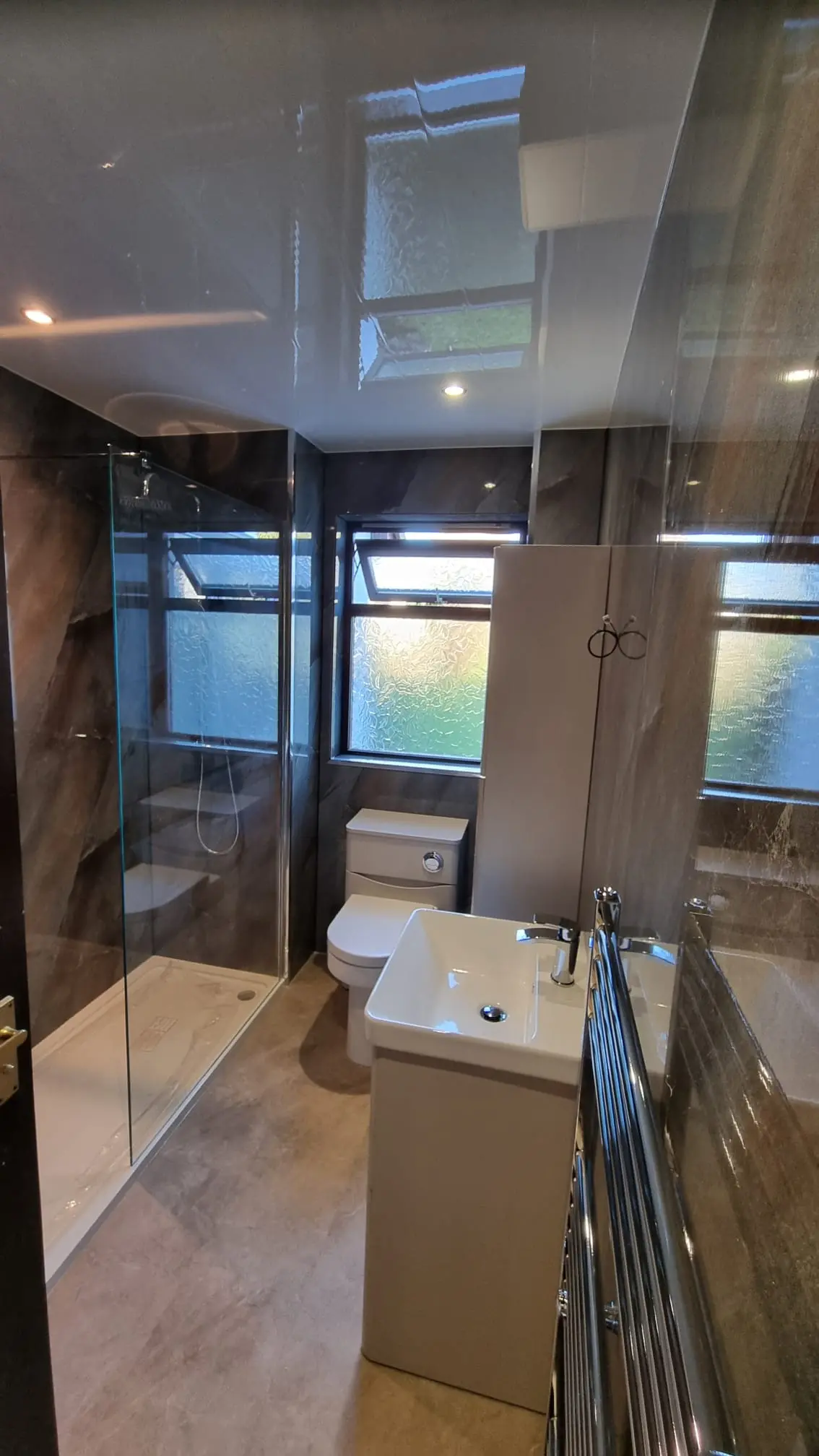
Quality LVT and wet wall panels carry 10–25 year manufacturer warranties and mostly outlive them — their real end is usually stylistic, not structural. Grout is the outlier: functionally it's a consumable pretending to be a finish, cracking and staining on a 5–10 year cycle that panel systems simply delete (the panels case). What genuinely ends finishes early is substrate movement and trapped moisture — installation sins, not material limits.
The Near-Immortals
Vitreous china doesn't wear — a WC pan or basin fails by impact or fashion, never fatigue (the 50-year-old steel tubs of ex-council stock make the same point in metal). Modern plastic pipework in the walls is genuinely long-lived; copper likewise, bar ancient fittings. This permanence is why "the suite's fine, it's everything around it" is the most common honest diagnosis we give — and why the envelope-first refit exists as a middle path.
When a Room Is Genuinely Done
Not at an age — at a condition: when the envelope stops keeping water contained (soft floor, staining below, seals failing faster than renewal), when the mechanism generation all wears at once (the year everything drips), or when the room's function no longer fits the household. Two of the three usually arrive together around the second decade — which is where the folklore number comes from, and where a refit stops being indulgence and starts being maintenance. If you're reading component symptoms in your own room, the replace vs refurbish guide is the decision tree.
Related reading: Replace vs refurbish, New bathroom vs refresh, Where spec money should go, Panels vs tiles.
Not sure which way to go in your own bathroom? Call 01236 801802 — a five-minute conversation usually settles it.