Once you've decided on wet wall over tiles — and our panels vs tiles guide makes that case — the next fork is finish. Matt or gloss isn't just taste: it changes how light moves in the room, what cleaning looks like, and how the panels age. Here's what a few hundred installs have taught us.
What the Finish Actually Changes
Same panel, same core, same waterproofing — the finish is the surface layer only. But that surface is the entire visible bathroom, floor to ceiling, and it behaves differently in four ways: how it reflects light, how it shows water residue, how it shows damage, and how it reads stylistically. None of these is decisive alone; the room decides which matters most.
The Case for Gloss
- Light amplification. A high-gloss surface effectively adds a soft mirror to every wall. In the small, single-window bathrooms of Cumbernauld's council-era stock — some barely 4 m² — gloss panels visibly lift the room. It's the closest thing to adding a window that a refit can do.
- The fast wipe. Smooth gloss releases soap residue with one pass of a squeegee or cloth — the daily-clean champion.
- The classic look. Gloss white and gloss marble-effect are the timeless bathroom finishes; they date slowly precisely because they were never fashionable, just default.
The honest cons: every water drop that dries leaves its outline, smears show in raking light, and a scratch in gloss catches the eye forever.
The Case for Matt
- Forgiveness. Matt scatters light, so watermarks, fingerprints and fine scratches largely vanish. Between cleans, a matt bathroom simply looks tidier.
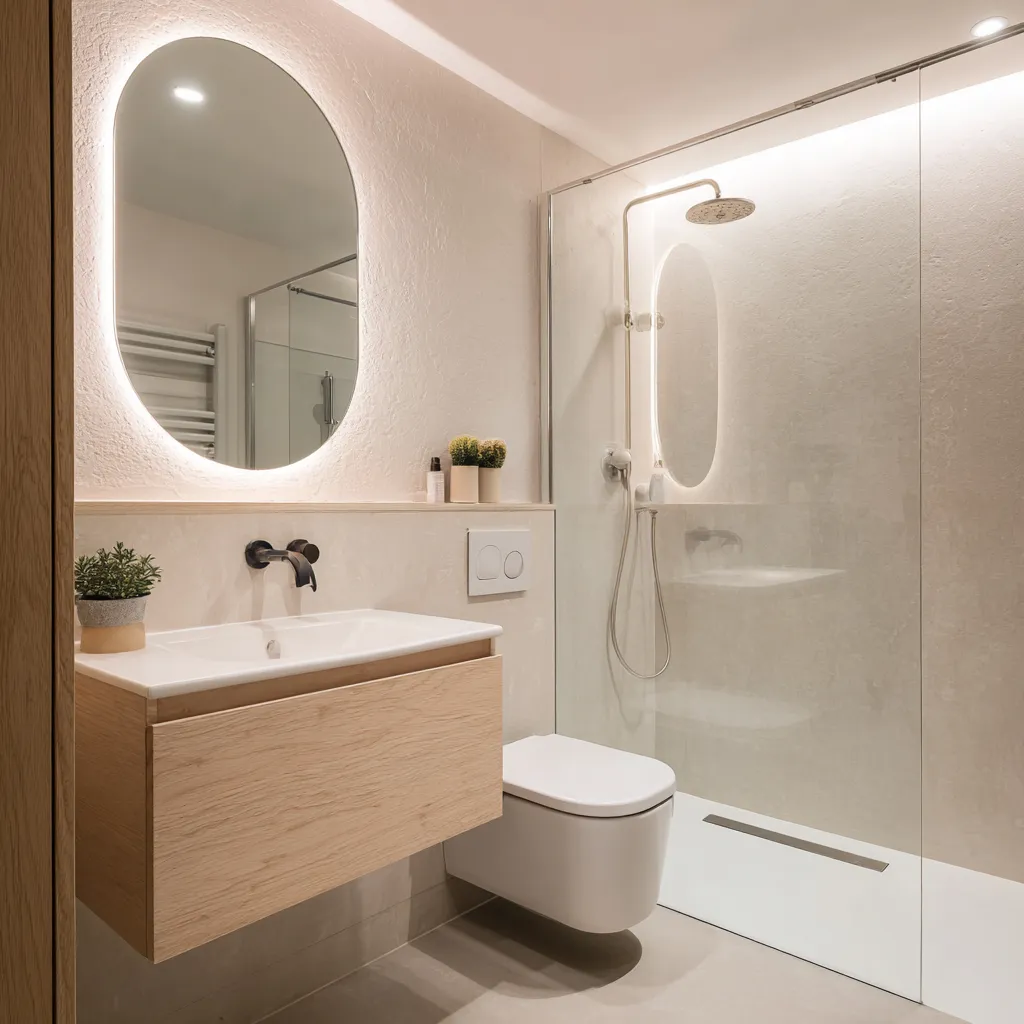
- Where style went. Matt stone, concrete-effect and warm matt neutrals are what the last decade of bathroom design has been built on — the finishes running through our recent fits and our 2026 trends guide.
- No glare. Under LED downlights and lit mirrors, gloss can throw hard reflections; matt rooms light evenly — kinder for make-up, shaving and photographs.
The trade: soap film builds less visibly but needs a slightly more deliberate clean when it does, and deep colours in matt can burnish to a sheen at high-touch points over many years.
The Scottish Soft Water Factor
Most anti-gloss advice online is written for England's hard-water counties, where every dried drop leaves a chalky limescale ring. Scotland's water is predominantly soft — dried drops leave far fainter marks, and the gloss maintenance burden is genuinely lower here (more in our soft water guide). If gloss suits your room, don't let hard-water horror stories talk you out of it.
Mixing Finishes in One Room
The strongest rooms often use both: matt on three walls, a gloss or textured feature wall behind the vanity or in the shower zone. It concentrates the light-bounce where it earns its keep and keeps the forgiving finish on the walls you brush past. Panel systems make this trivial — same profile, different face.
Choosing Without Regret
Look at your room at its darkest hour, not its brightest. If it needs light, weight gloss. If it gets light, take matt and enjoy the low-maintenance decade. And judge samples at home, on your wall, in your lighting — brochure photography flatters gloss and flattens matt, which is exactly why we bring physical samples to every design visit.
Related reading: Wet wall panels vs tiles, Best wet wall brands UK, Scotland's soft water and your bathroom, Wet wall bathrooms.
Not sure which way to go in your own bathroom? Call 01236 801802 — a five-minute conversation usually settles it.