Read any UK bathroom care guide and count the limescale mentions — descaling shower heads, squeegeeing glass before the chalk sets, avoiding matt black taps because scale shows. Now check where that advice was written. Scotland's upland reservoirs deliver some of the softest mains water in Britain, and it quietly rewrites a surprising amount of the rulebook. Here's what actually changes.
Why Scottish Water Is Soft
Hardness is dissolved calcium and magnesium, picked up when rainwater percolates through chalk and limestone. England's south and east sit on exactly that geology; Scotland's water mostly falls on hard, old, insoluble rock and runs off into reservoirs without collecting minerals. Result: mains water across the central belt is classified soft to very soft. It's the same reason Scottish water makes better tea and famously good whisky — and the same chemistry reaches your shower head.
The Limescale Non-Problem
Limescale is what hard water leaves behind when it dries or heats: the white crust on kettles, heads and glass. In soft-water Scotland that deposit is minimal — which is why Scottish kettles stay clean for years while a London kettle furs in a month. Bathroom consequences:
- Shower heads keep their spray pattern without quarterly vinegar baths
- Glass screens don't develop the baked-on chalk haze — dried drops leave faint mineral ghosts at worst
- Electric shower heater cans — the component scale kills in hard-water England — live noticeably easier lives here (one reason phased-shutdown features matter less; see the electric shower guide)
- Taps and valves keep their flow; aerators don't clog with grit
Choices This Frees Up
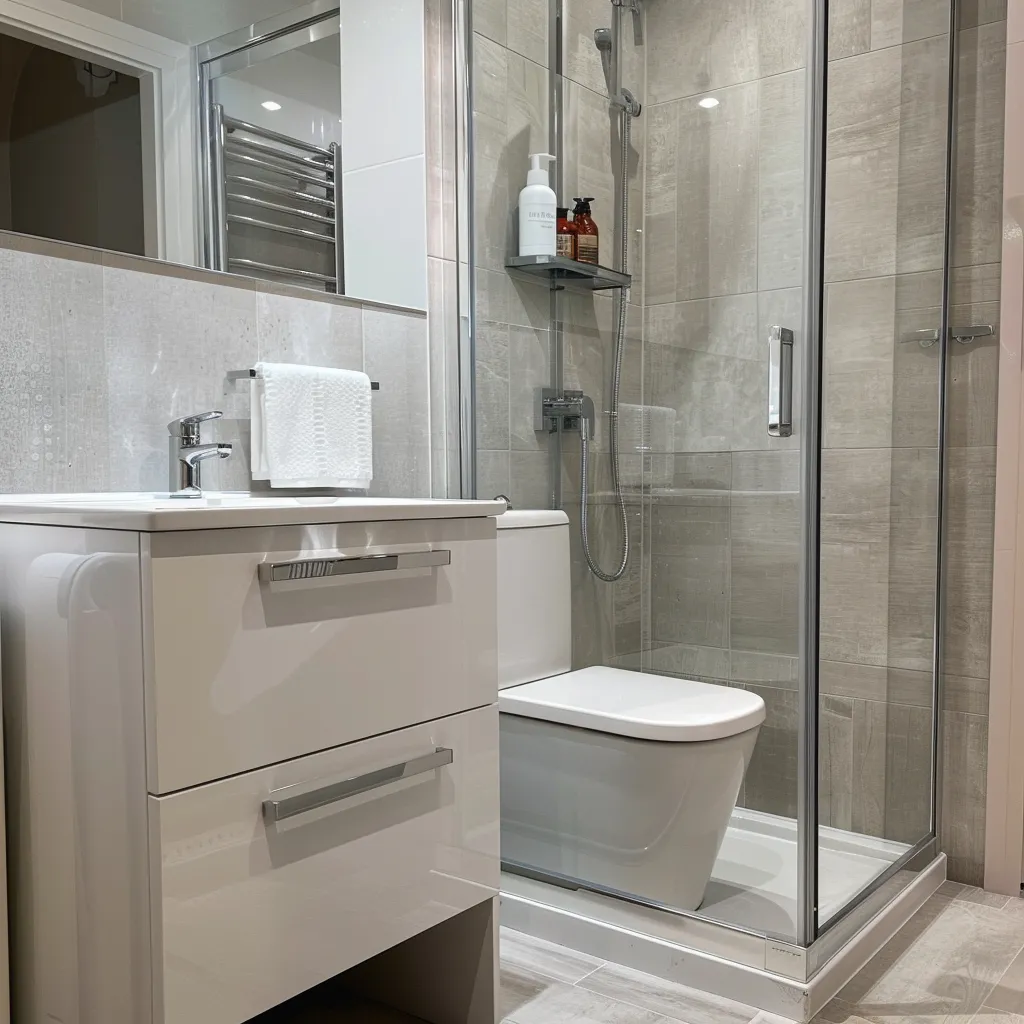
Advice you can politely ignore in Scotland: "avoid gloss panels — watermarks" (they're faint here — our matt vs gloss guide covers it); "matt black brassware shows every scale spot" (with minimal scale, matt black stays matt black — part of why the finish thrives here, per our finishes comparison); "frameless glass is high-maintenance" (a squeegee habit helps anywhere, but the penalty for lapsing is a fraction of the hard-water version). Choose finishes on looks and room logic, not on a scale problem you don't have.
Soft Water's Own Quirks
Two to know. Soap behaves differently: it lathers enthusiastically and rinses slowly — that "can't get the soap off" feeling is soft water's signature, not poor rinsing, and it means less product goes further. Residue on surfaces is soap film rather than mineral scale — different cleaner, same wipe. Metal chemistry: very soft water is mildly more aggressive toward some metals than scale-saturated hard water (scale actually coats and protects pipework in the south). Modern brassware and plastic pipework don't care; it's one more reason quality chrome plating beats bargain-bin brass.
Cleaning in Soft Water
Skip the descalers — you barely need them. Your routine is soap-film management: a squeegee pass on glass, a mild bathroom cleaner weekly, and matt surfaces hiding whatever you skip (the forgiving-finish logic from the finish guide). Scottish bathrooms genuinely stay presentable on less effort than the same room would take in Kent.
The Caveat Paragraph
"Predominantly soft" isn't "universally soft" — hardness varies by supply zone, and Scottish Water publishes the figure for any postcode. If you've moved from England with a water softener in the removal van: sell it, you're done. And private supplies (rare in town, real in the countryside) play by their own rules entirely.
Related reading: Matt vs gloss wet wall, Tap finishes compared, Electric shower brands compared, Bathroom mould causes & fixes.
Not sure which way to go in your own bathroom? Call 01236 801802 — a five-minute conversation usually settles it.