Shower doors are bought in thirty seconds and opened three thousand times a year. The style question — chrome or matt black, framed or frameless — gets all the attention, but the mechanism question decides whether the bathroom works: whether the door clears the WC, whether it seals, and whether it still rolls smoothly in year eight. We covered frame styles in frameless vs framed — this is the mechanics.
Start With Clearance, Not Style
Stand in your bathroom doorway and look at where the enclosure will go. What's within 700 mm of its opening? In the compact rooms we fit across Cumbernauld the answer is usually "the WC" or "the basin" — and that answer eliminates half the door catalogue before taste gets a vote. Every door type is a different answer to the same question: where does the opening glass go when it opens?
Pivot: Simple and Solid
The pivot door swings like a normal door on a hinge point. It's the mechanism with the fewest wearing parts — no rollers, no tracks, no folding joints — which makes it the durability pick, and the widest, most dignified entry for any given opening. The cost is swing space: a 760–900 mm door needs its arc clear of everything, every time. Right for: enclosures facing open floor. Wrong for: doors that would clip the WC, which is most tight corner installs.
Sliding: The Wide-Opening Default
From 1000 mm of opening upward, sliding doors take over: the glass parks over the fixed panel, needing zero room-side clearance. On the 1200 × 800 offset enclosures that dominate our bath-to-shower conversions, a slider is the standard answer. The wearing part is the roller set — on quality doors they're smooth, quick-release for cleaning, and replaceable; on cheap doors they're none of those, and the door tells you within two years.
Bi-Fold: The Tight-Room Tool
Bi-fold doors concertina inward, needing almost no clearance inside or out — the engineering answer to "the WC is right there". They're genuinely clever and they've rescued plenty of 800 mm-opening layouts. The honest trade: the most hinges, tracks and seals of any type, folded glass panels that halve the entry width, and more edges to squeegee. Buy the best bi-fold you can or expect to meet its moving parts again.
The No-Door Alternative
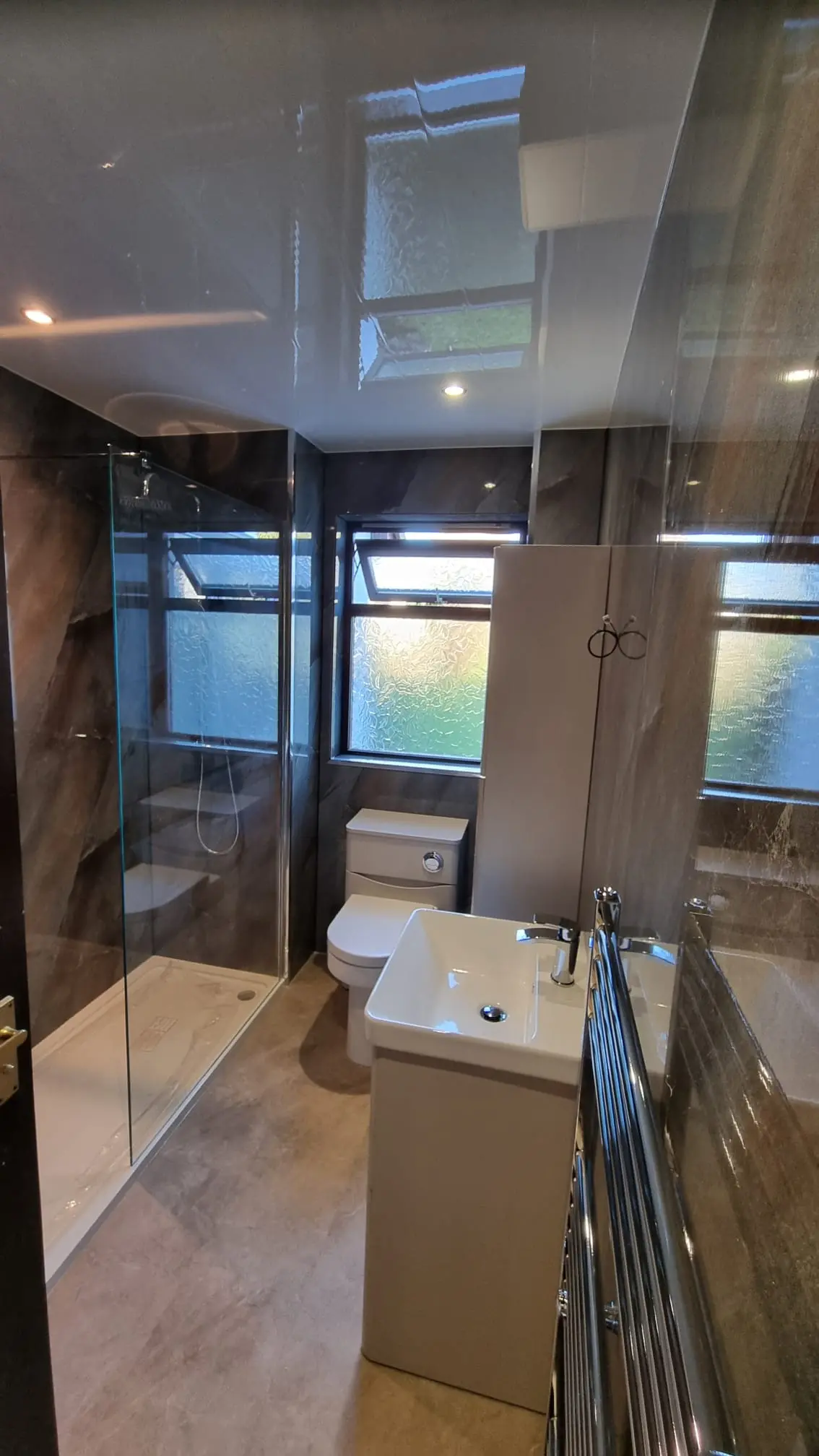
Given 1400 mm-plus of enclosure run, a single fixed panel with an open entry deletes every mechanism from the conversation: nothing to roll, fold, seal or squeak, and cleaning becomes one flat sheet. It needs width to manage splash, and the room benefits from warmth planning — the walk-in logic covered in wet room vs walk-in shower. When the room allows it, it's what we'd fit in our own houses.
What Quality Looks Like in a Door
- Glass: 6 mm toughened as the sensible floor — 4 mm budget doors feel like it
- Rollers/hinges: metal internals, replaceable, quick-release on sliders
- Seals: replaceable strip seals — every door seal wears; the question is whether it's a £10 part or a new door
- Adjustment range: real-world walls aren't plumb; a door with generous fitting tolerance goes in square and stays square
Every enclosure we fit is levelled, sealed and load-tested as part of the install — and the fit, not just the door, is what the workmanship guarantee covers.
Related reading: Frameless vs framed screens, Enclosure shapes compared, Wet room vs walk-in shower, Bath to shower conversions.
Not sure which way to go in your own bathroom? Call 01236 801802 — a five-minute conversation usually settles it.