It's the most common fork in the road on a home visit: the room only fits one or the other done properly, so do you keep the bath or go all-in on a shower? The internet answers this question with "it depends" — which is true but useless. Here's the actual decision framework we talk through at kitchen tables across Cumbernauld every week.
Start With Who Actually Uses It
Not who might use it. Who does. Get the last six months honest: if the bath's had three uses and two of them were soaking a paint roller, you have a shower household with a bath-shaped storage shelf. Equally, if you've got a toddler, a dog, or a habit of aching joints after work, the bath earns its floor space several times a week.
The mistake we see is designing for a hypothetical: the visitor who might want a bath, the baby you might have, the buyer you might sell to in fifteen years. Design for the household you are, hedge sensibly for the one you might become, and give the hypotheticals a vote — not a veto.
The Resale Question, Honestly
Estate agents will tell you a family house with no bath loses some family buyers — and in our experience that's true, but it's narrower than the folklore suggests. What actually matters:
- Two-bathroom homes: nobody cares. Keep a bath in one, shower the other. Do what you like.
- One-bathroom family homes (3+ beds): this is the risk zone. Buyers with babies and toddlers do filter for a bath. If you might sell within ten years, think twice before removing it entirely.
- One and two-bed flats: the calculus reverses. Downsizers and first-time buyers increasingly prefer a good walk-in shower, and level access is a genuine selling point to older buyers — a big share of the Cumbernauld flat market.
There's a fuller breakdown of what bathrooms do to Scottish sale prices in our does a bathroom add value guide.
What Each Does With the Space
A standard bath claims 1700 mm × 700 mm of wall run — in a typical 1.9 m × 1.7 m Cumbernauld council-era bathroom, that's an entire wall. Replace it with a 1200 mm walk-in enclosure and you free up half a metre of wall for a proper vanity, a tall storage unit, or simply room to towel off without elbowing the radiator.
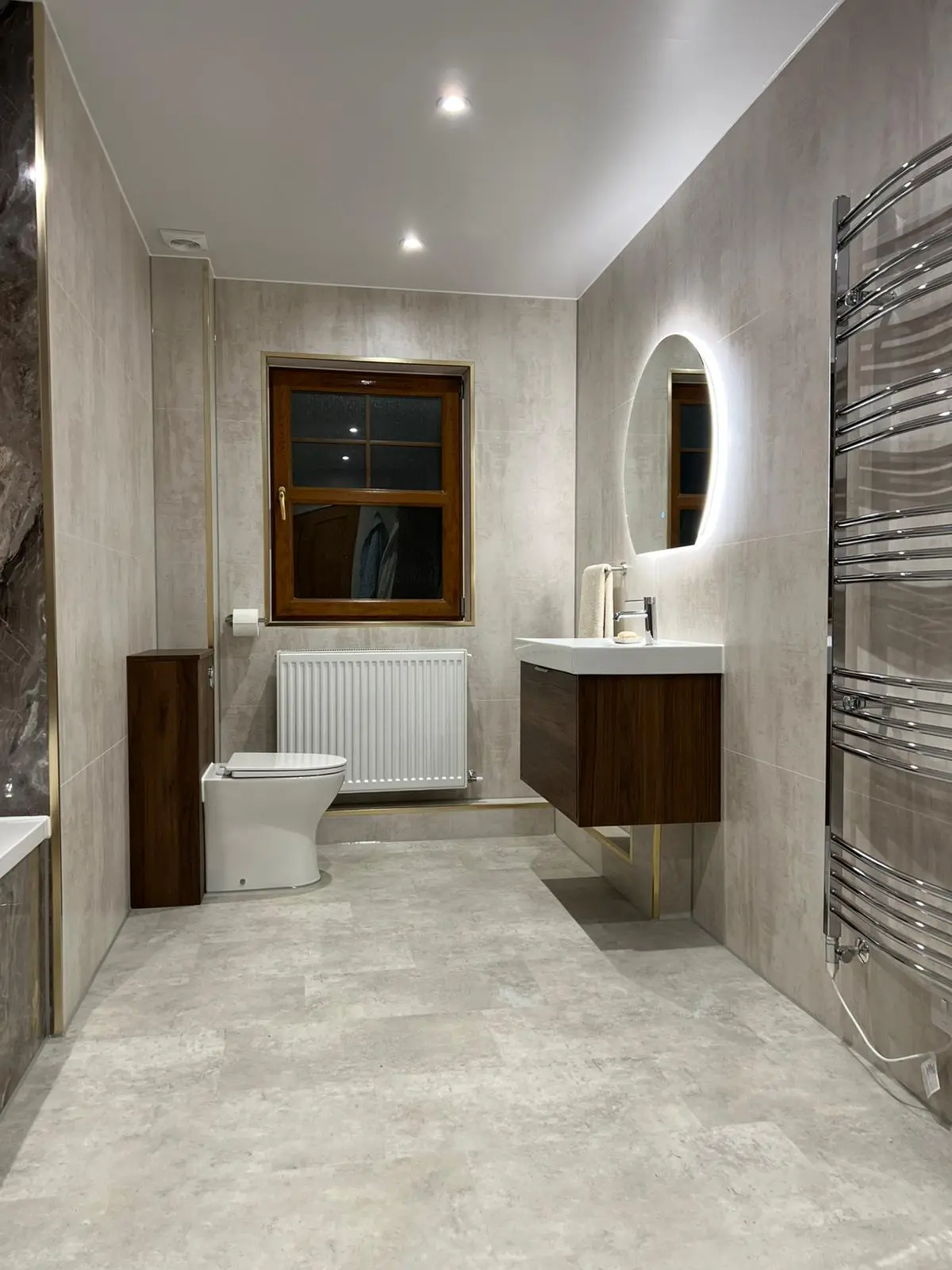
The shower also wins on the practical stuff: easier to clean, safer to step into for anyone over sixty, and less condensation load on the room because you're not evaporating a hot tub of water. Our wet room vs walk-in shower guide covers what to put in its place.
Cost Comparison
- Bath-to-shower conversion: from £2,299 fitted — the most popular single job we do. Full details on our conversion page.
- New bath in a full refit: no premium either way — a quality acrylic bath and a quality shower tray and enclosure land within a couple of hundred pounds of each other inside a £3,699 full package.
- Keeping both (shower over bath): the cheapest hedge — a thermostatic shower, a decent screen and full-height wet wall over the bath adds modest cost to a refit.
The Have-Both Options
Two designs get you a real shower without losing the bath:
- Shower over bath, done properly: not the dribbling mixer tap of your childhood — a thermostatic valve, a fixed glass screen and wet wall to the ceiling. Works in any bathroom that keeps its bath.
- P-shape or L-shape shower bath: the bath widens at the shower end to give you proper elbow room. A very good answer in family homes that can't fit both separately.
Our Verdict
Staying long-term with no small children and no bath habit? Convert to a walk-in shower and don't look back. Family house, one bathroom, might sell? Fit a P-shape shower bath — you give up almost nothing and keep every buyer. Two bathrooms? Keep one bath somewhere and put the best shower you can afford in the other.
Related reading: Bath to shower conversions, Wet room vs walk-in shower, Does a bathroom add value in Scotland?, Walk-in shower cost guide.
Not sure which way to go in your own bathroom? Call 01236 801802 — a five-minute conversation usually settles it.