Nearly every guide you'll find on Scottish building warrants was written about a house. That's a problem in Cumbernauld, because a large share of the town is deck-access blocks, mid-rise flats and maisonettes — and the warrant rules genuinely are different for them. If you live in a flat and you've read somewhere that "bathrooms are exempt", the honest answer is: not necessarily, and not in the same way.
The Two Things People Mix Up
Before anything else, separate these. They're different questions and the answers don't follow each other.
Question one: do I need a building warrant? That's about permission — whether you have to apply to the council and pay a fee before starting.
Question two: does the work have to meet building standards? That's about quality — the ventilation rate, the electrical safety, the drainage, the hot-water temperature.
The Scottish Government uses fitting a new bathroom as its own worked example of the distinction: minor work that must meet the standards while quite possibly not requiring a warrant. So "no warrant needed" is not a green light to do as you please. It means nobody from the council is coming to check — which, if anything, puts more weight on who you hire.
Scottish Government / mygov.scot, Scottish building standards.What Houses Get
The current Domestic Technical Handbook sets out categories of work that don't need a warrant. For an ordinary house, those can take in a fair amount of what a bathroom project involves — forming an en-suite or shower room with its drainage, the electrical work, non-loadbearing partitions, extract ducting and certain sanitary pipework penetrations.
It isn't unconditional even then. The exemptions fall away for structural work, anything affecting a wall separating you from a neighbour, changes to how wastewater actually discharges, and relevant work in a house with a storey more than 4.5 metres up.
Scottish Government, Domestic Technical Handbook, April 2026, clauses 0.5.1–0.5.2. Guidance on meeting the Building (Scotland) Regulations 2004 — the verifier decides individual cases.Why Flats Are Treated Differently
Here's the part that matters if you're in a block: flats and maisonettes do not have the same broad exemption. That's the plain position in the handbook, and it isn't an oversight.
Think about what's physically different. In a house, your floor sits on your foundations and your waste runs to your own drain. In a flat, your floor is someone's ceiling. Your soil stack is very often shared. The wall you'd like to take out may be doing structural work for the whole building, or separating you from a neighbour. The consequences of getting it wrong don't stop at your front door — and the regulations reflect that.
There's a second layer in a block, too, and it isn't building standards at all: your title deeds and your factor. Shared stacks and common parts frequently come with notification obligations that have nothing to do with the council. We've seen more jobs delayed by a factor's paperwork than by a warrant application.
What That Means in Cumbernauld
Cumbernauld is a New Town, so the housing mix skews harder toward flats than most Scottish towns of its size. The deck-access blocks and low-rise courts across Kildrum, Seafar, Carbrain and Abronhill are exactly the properties where the house-versus-flat distinction bites — and exactly the properties where a generic UK bathroom blog will lead you astray.
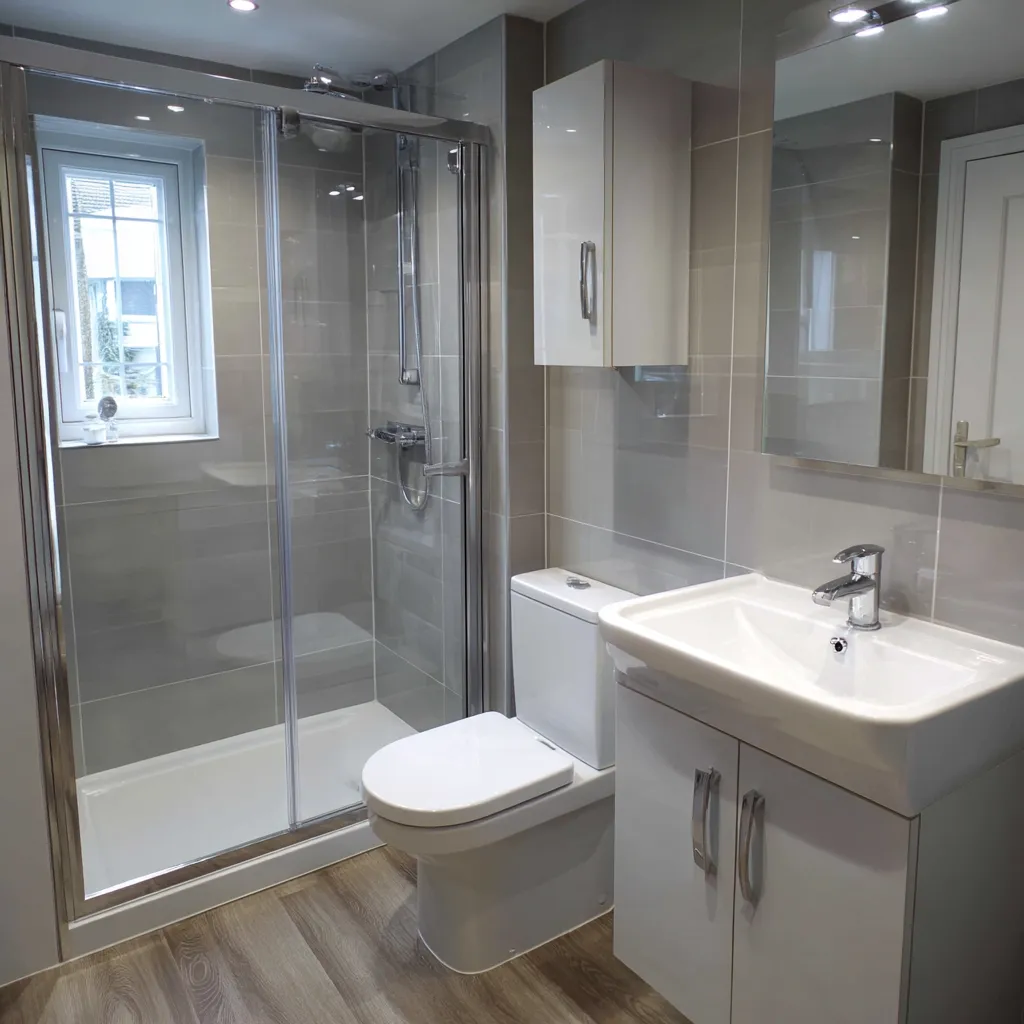
In practice, for the majority of what we're asked to do in these flats — strip out, new wet wall, new flooring, new suite in roughly the same positions, upgraded extractor — a warrant usually isn't the issue. The things that change the answer are moving the WC any real distance, touching the shared stack, taking out a wall, or altering how waste leaves the building.
Not sure which side of the line your job falls on? We'll tell you at the home visit, before you've committed to anything — and if it's genuinely borderline, we'll say so rather than guess.
Book a free home visit Call 01236 801802Work That Pushes You Into Warrant Territory
Not a legal test — the verifier decides that — but this is the list that makes us pick up the phone to the council rather than proceed on assumption:
- Removing or altering a wall where there's any question of it being loadbearing, or where it separates you from a neighbouring property.
- Changing how wastewater discharges — not just moving a pipe, but altering the method or the point it leaves the building.
- Moving the soil stack, or connecting into a shared stack differently from how you currently connect.
- Forming a new room rather than refitting an existing one — an en-suite carved out of a bedroom is a different proposition in a flat than in a house.
- Anything structural to the floor, which in a flat is also a neighbour's ceiling and often part of the fire separation between dwellings.
Worth saying: needing a warrant isn't a disaster. It's an application, a fee and a wait. What causes real trouble is discovering you needed one after the work is done — at which point you're in retrospective territory, which is slower, dearer and occasionally awkward when you come to sell. The Home Report is where unwarranted work tends to surface.
How to Get a Straight Answer
Ask the verifier. In Cumbernauld that's North Lanarkshire Council's building standards team, and they answer this kind of question routinely — it's the job. Go to them with the property type, the address, and a clear description of what you want to change, particularly anything involving walls, the stack or the drainage.
What you should expect from any fitter worth hiring: that they raise this before you've paid a deposit, that they can tell you which parts of your job are the sensitive ones, and that they never tell you a warrant is definitely not required for a property they haven't seen. If a quote arrives with a confident answer on warrants and nobody has been to look at the flat, that's a tell.
For the wider picture — ventilation rates, electrical standards, water efficiency — the Scottish building regulations guide covers what your bathroom has to achieve once the warrant question is settled.
Related reading: Scottish building regulations for bathrooms, where the soil stack sits by block type, what it costs to move a toilet in a deck-access flat, and our fitting team.
Live in a Cumbernauld flat and wondering where you stand? Call us on 01236 801802. We've worked in most block types in this town and we'll give you a straight answer — including "ask the council" when that's the honest one.