Scottish building law is different from the rest of the UK. Bathroom renovations are governed by the Building (Scotland) Regulations and the Scottish Building Standards — administered locally by your council (in Cumbernauld's case, North Lanarkshire). The good news is that most bathroom remodels don't need a Building Warrant. The bad news is that "most" isn't "all" — and the exceptions matter.
Do You Need a Building Warrant?
A Building Warrant is the Scottish equivalent of England's Building Regulations approval. It's permission, granted by your local council before work starts, to carry out building work. North Lanarkshire Council handles warrants for properties in Cumbernauld, Kilsyth, Moodiesburn and the surrounding G65–G69 postcodes.
For a bathroom, you do not need a Warrant if:
- You're replacing fixtures in their existing positions (bath, basin, WC, shower)
- You're re-tiling or fitting wet wall
- You're laying new flooring
- You're replacing a like-for-like extractor fan
You do need a Warrant if:
- You're adding a brand-new bathroom (e.g. converting a cupboard into a cloakroom WC)
- You're moving the WC to a different location (because it changes the soil pipe routing)
- You're making structural alterations (knocking through a wall, removing a load-bearing element)
- You're installing a new soil-and-vent stack or making major drainage changes
- You're converting a bathroom into a wet room with significant floor structure changes
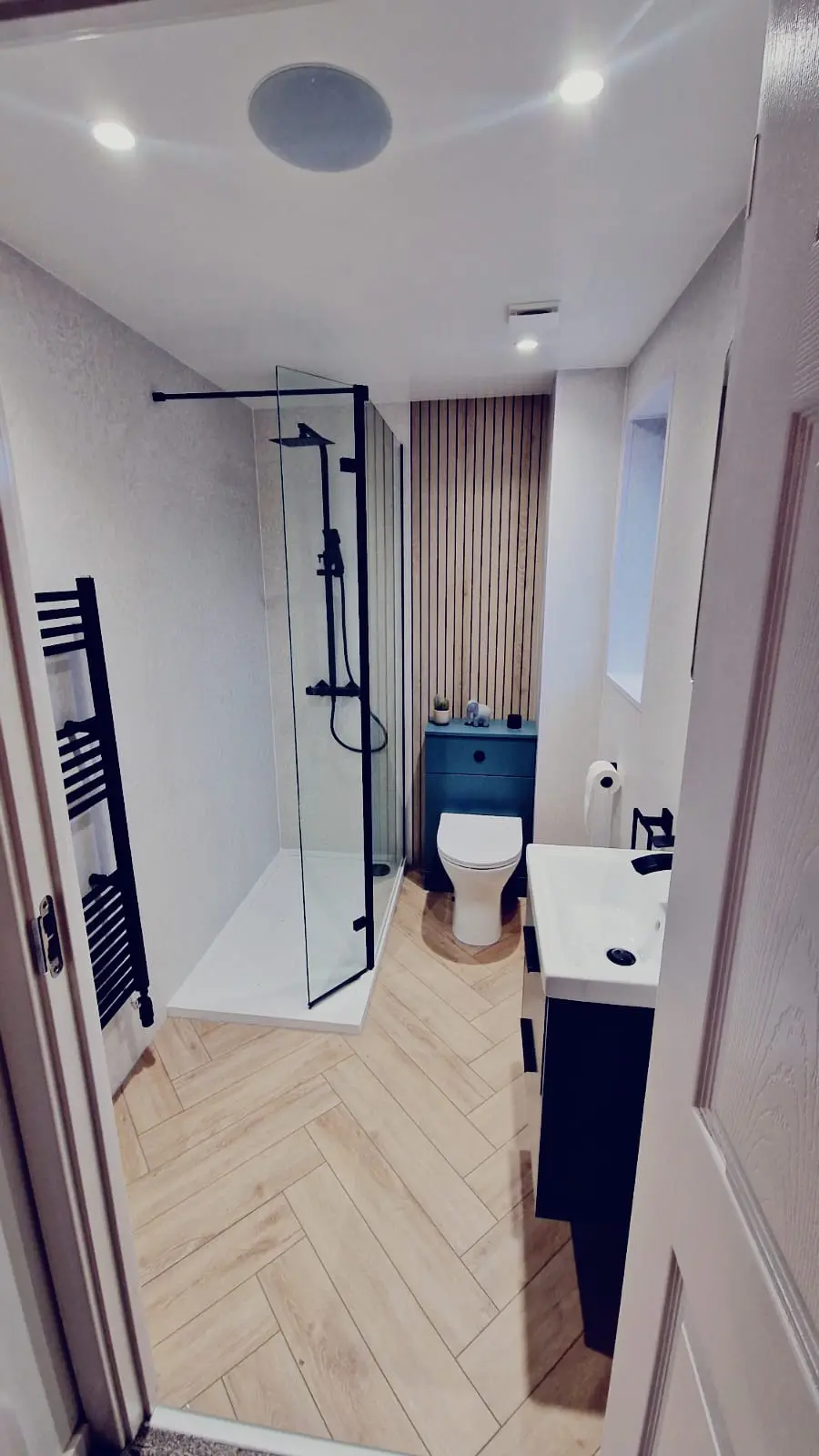
The standard like-for-like fitted bathroom — including a wet wall conversion, walk-in shower upgrade, new flooring and a new extractor — is normally below the Warrant threshold. We'll flag it on the home visit if your project crosses the line.
Electrical Work — Part P-Equivalent in Scotland
Bathrooms in Scotland are subject to the same wiring rules as the rest of the UK (BS 7671 — the IET Wiring Regulations). Bathroom zones (0, 1, 2 and outside zones) determine what electrical equipment can go where, with strict rules about ingress protection (IP) ratings.
In practice this means:
- All electrical work in a bathroom must be carried out by a registered electrician (SELECT or NICEIC accredited in Scotland).
- The work must be issued with an Electrical Installation Certificate on completion.
- Lighting, extractor fans, shaver sockets and electric showers must be specified to the correct IP rating for the zone they're in.
- Existing circuits often need RCD protection retrofitted if they don't already have it.
Our installations include certified electrical work as standard — you'll receive the certificate at handover, which you'll need if you ever sell the property.
Ventilation — The Rule That Catches People Out
Section 3 of the Scottish Building Standards requires mechanical extract ventilation in every bathroom that doesn't have an opening external window of adequate size. Even where there is a window, mechanical extraction is recommended for any bathroom without natural cross-ventilation.
The minimum extract rate for a domestic bathroom is 15 litres per second intermittent extract, or 8 l/s continuous. The fan must vent to outside — not into a loft space. Older Cumbernauld properties (particularly the 1960s deck-access flats in Kildrum and Seafar) sometimes have extractor fans venting into ducting that just terminates in the ceiling void; that's not compliant and we replace it as part of the install.
Drainage and Waste
The Scottish Building Standards Section 3.7 (sanitary facilities) and Section 3.8 (drainage) cover what you can and can't do with bathroom waste. The two practical takeaways:
- WC waste must connect to the soil-and-vent stack with the correct fall and the correct trap. Moving a WC to a position more than ~2 m from the existing stack usually requires either a major waste re-route or a macerator unit (Saniflo or similar). Macerators are allowed but they're a backup option, not a primary WC.
- Shower and bath waste need a 75 mm trap (40 mm in some cases) and a fall of at least 1:80 toward the stack. We design this in as part of the layout planning.
Accessibility Provisions
If you're designing for current or future accessibility — common in older homeowners or households planning for the long term — Section 4 of the Scottish Building Standards sets out the dimensions and clearances. We cover the practical implications in our accessible bathroom design guide.
Listed and Conservation Properties
Most Cumbernauld housing is post-war and not listed. The exceptions are some properties in Cumbernauld Village (within or near the conservation area) and certain individually-listed buildings in Kilsyth. For these:
- Internal alterations to a listed building may require Listed Building Consent — even if no Building Warrant is needed for the same work.
- Conservation areas mainly affect external works, not internal bathroom layouts — but if your renovation involves a new external extractor outlet, that might need consultation with North Lanarkshire planning.
If you're unsure, North Lanarkshire Council's planning team will give a free informal opinion before you commit.
What We Handle for You
For the bathrooms we fit, we handle the technical compliance side as standard:
- Certified electrical work by a SELECT-registered electrician
- Compliant mechanical ventilation, vented to outside
- Correct waste falls and trap sizes
- IP-rated lighting and fittings appropriate to each bathroom zone
- Electrical Installation Certificate at handover
If the work crosses into Building Warrant territory (new bathroom, structural change, major drainage), we'll tell you on the home visit and either submit the Warrant application on your behalf or recommend a local building surveyor to handle it.
Related reading: wet room vs walk-in shower, waterproofing and tanking, and the official Scottish Building Standards introductory guide. See our full service range on the homepage.
Call us on 01236 801802 if you want to talk through whether your project needs a Warrant. We answer that question free, even if you don't go on to book the work.