Picking a shower is the kind of decision people put off for weeks. There are three main types, the difference matters, and the right answer depends almost entirely on what type of plumbing your home has — not on personal preference. This guide explains the three options in language you can actually use, and tells you which one we'd fit in your specific house.
Check Your Plumbing System First
Before you even look at brands, you need to know what's heating your water. Two systems dominate UK homes:
Combi boiler (most common)
A wall-mounted boiler heats hot water on demand. No tank in the airing cupboard. The hot water comes out at mains pressure — same as the cold. Most homes built or refurbished since 2000 have one. Around 70% of Cumbernauld bathrooms we fit are on combi.
Gravity-fed (older system)
A cold water tank in the loft and a hot water cylinder in the airing cupboard. Hot water comes out under gravity pressure — much weaker than mains. Common in pre-2000 properties, especially the original Cumbernauld New Town flats and older sandstone tenements.
You can identify a combi system in 30 seconds: open a hot tap, then open another hot tap. If the flow stays strong, you've got a combi. If it drops noticeably, you're on gravity.
Mixer Showers — The Default Choice
A mixer shower blends hot and cold water from your existing supply and delivers it through the showerhead. It doesn't heat the water itself — it just mixes what's already there. Three sub-types:
- Manual mixer — single lever to control both temperature and flow. Cheapest, but temperature drifts when someone runs a tap elsewhere.
- Thermostatic mixer — separate temperature and flow controls, with a built-in thermostat that keeps the temperature locked. Standard fit on every bathroom we install. Anti-scald protection is built in.
- Digital mixer — electronically controlled, often with a remote control or wall-mounted screen. Slick but expensive; not necessary for 95% of bathrooms.
Best for: any home with a combi boiler, or a gravity system with decent pressure. Quiet, reliable, fits any rainfall or handheld shower head, and the controls feel premium.
Watch out for: low-pressure gravity systems. If your hot water trickles, a mixer shower will trickle too. We'd specify a power shower or electric instead.
Typical price (supply + fit): £450–£950, included in any of our bathroom packages.
Electric Showers — Independent & Simple
An electric shower is essentially a mini-boiler bolted to the bathroom wall. It takes cold water from the mains, heats it on demand using an internal electric element, and pushes it out through the showerhead. It doesn't need any hot water from your boiler or tank.
Best for:
- Houses where hot water reliability is patchy (older boilers, large families showering at the same time)
- Second bathrooms or en-suites where you don't want to drain the hot tank
- Properties where running new hot water pipework is awkward — common in some older Kilsyth and Cumbernauld Village stone cottages
- Customers who specifically want a shower that runs even if the boiler breaks down
Watch out for:
- Flow rate is limited by the heating element. A 9.5 kW shower delivers a noticeably weaker stream than a mixer fed by a combi.
- Higher kW units (10.5 kW+) need a dedicated cable run from the consumer unit. We'd usually upgrade to a higher-rated cable as part of the install.
- Less premium feel — the controls are usually plastic dials rather than the metal levers of a thermostatic mixer.
Typical price (supply + fit): £350–£650 for the shower itself plus electrical work.
Power Showers — Pumped Pressure
A power shower is essentially a mixer shower with a built-in pump. It mixes hot and cold water from the existing system and boosts the pressure with an internal pump motor. Volume is significantly higher than any non-pumped option.
Two important caveats:
1. Power showers only work on gravity-fed systems. They need a hot water tank to draw from. They cannot be fitted to combi boilers — the boiler can't supply the volume the pump demands. If you've got a combi and you want better pressure, the answer is a high-flow mixer, not a power shower.
2. Power showers use a lot of water. Typically 12–18 litres per minute, compared with 6–10 for an electric and 8–12 for a mixer. If you're on a water meter, that adds up. If you've got a small hot water tank, you'll empty it in 8–10 minutes flat.
Best for: homes with a gravity-fed system and weak pressure, where the customer wants a noticeably more powerful shower than the system can deliver passively. Some original Kildrum, Seafar and Abronhill flats benefit hugely from a power shower upgrade.
Typical price (supply + fit): £550–£900.
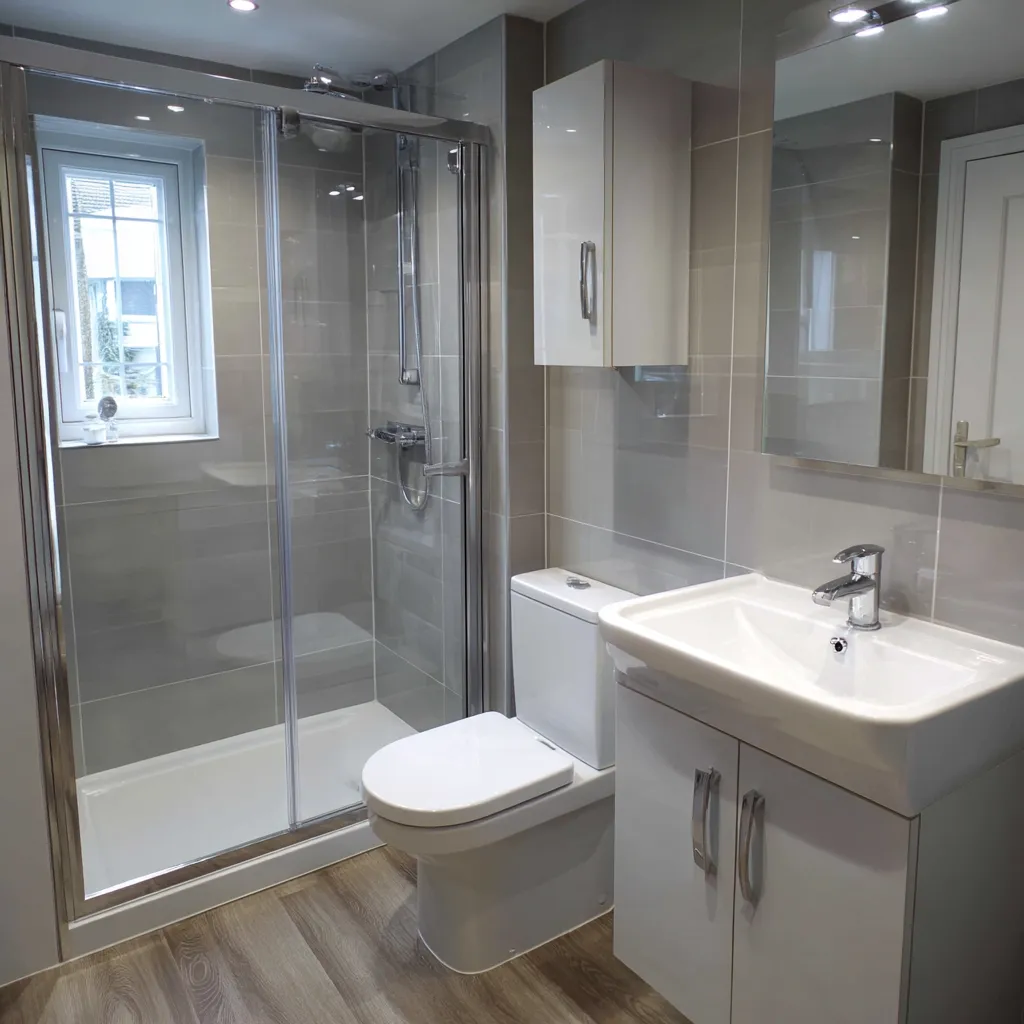
Which One Suits Your Home?
Here's how we'd recommend in different scenarios:
Modern detached or semi (Balloch, Smithstone, Craigmarloch, Blackwood)
Almost certainly a combi boiler. Thermostatic mixer shower is the right answer — fits any rainfall or handheld head, premium feel, no compromises.
CDC-era flat (Kildrum, Seafar, Carbrain, Abronhill)
Often gravity-fed with weak pressure. Two good options: power shower if you want maximum flow, or electric shower if you want independence from the hot tank. We'd usually pick electric for a smaller household and power for a family.
Period villa (Uddingston, Bishopbriggs, Stepps)
Mixed — depends whether the boiler's been upgraded. If still on a tank and cylinder, a thermostatic mixer with a high-flow head works if the pressure's good. If pressure's poor, power shower.
Tenement flat (Coatbridge, Airdrie, Motherwell, Wishaw)
Combi conversions are common but not universal. If still on a tank, a thermostatic mixer or power shower depending on pressure. If converted to combi, definitely a thermostatic mixer.
Second bathroom or en-suite
If the main bathroom is on a mixer fed by a combi, an en-suite mixer pulls from the same supply — quality drops if both run at once. Electric shower in the en-suite avoids the conflict cleanly.
Related reading: wet room vs walk-in shower, bathroom electrics & IP zones, our walk-in shower service.
Not sure which suits your specific setup? Call us on 01236 801802 — we'll ask three quick questions and tell you what we'd fit in your home.