Our 2026 trends guide tells you what's current. This is its sceptical twin: which of today's looks will read as "very 2026" by the end of the decade — and how to enjoy trends anyway without your bathroom becoming a time capsule. Written with the humility of a trade that installed avocado suites sincerely, the first time round.
How Dating Actually Works
Finishes don't expire on merit — they expire on saturation. A look spreads until it signals its installation date, and the more precisely datable, the faster it curdles: avocado means 1975, beige-square-tiles means 2005, grey-everything means 2018. The mechanism accelerates now because trends propagate through the same three feeds into everyone's plans simultaneously — mass adoption is faster, so the signature forms sooner. The corollary is comforting: things that were never the look can't date, which is why white sanitaryware from any decade still reads as bathroom rather than as year.
The 2030 Watchlist
Held to honestly-argued suspicion, not certainty:
- Saturation-phase signatures: fluted and reeded surfaces everywhere at once; arched mirrors as the default shape; boucle-and-brass vignettes — current darlings at the everywhere stage of the cycle
- Colour-locked schemes: sage green fittings and forest-green panels are 2024–26's signature hue; loved properly, but a built-in colour commitment is a dated commitment (do it in paint, not panels)
- Terrazzo-print everything: the pattern's second lap of the feed already
- Matt black brassware — the caveat case: superb, still strong locally, and soft Scottish water treats it kindly (why); but ubiquity is doing its work, and it's a swappable layer anyway — hold it lightly, not fearfully
- Micro-trend tech: the gadget layer (app-controlled everything) dates on software-years, faster than any finish
What Reliably Survives
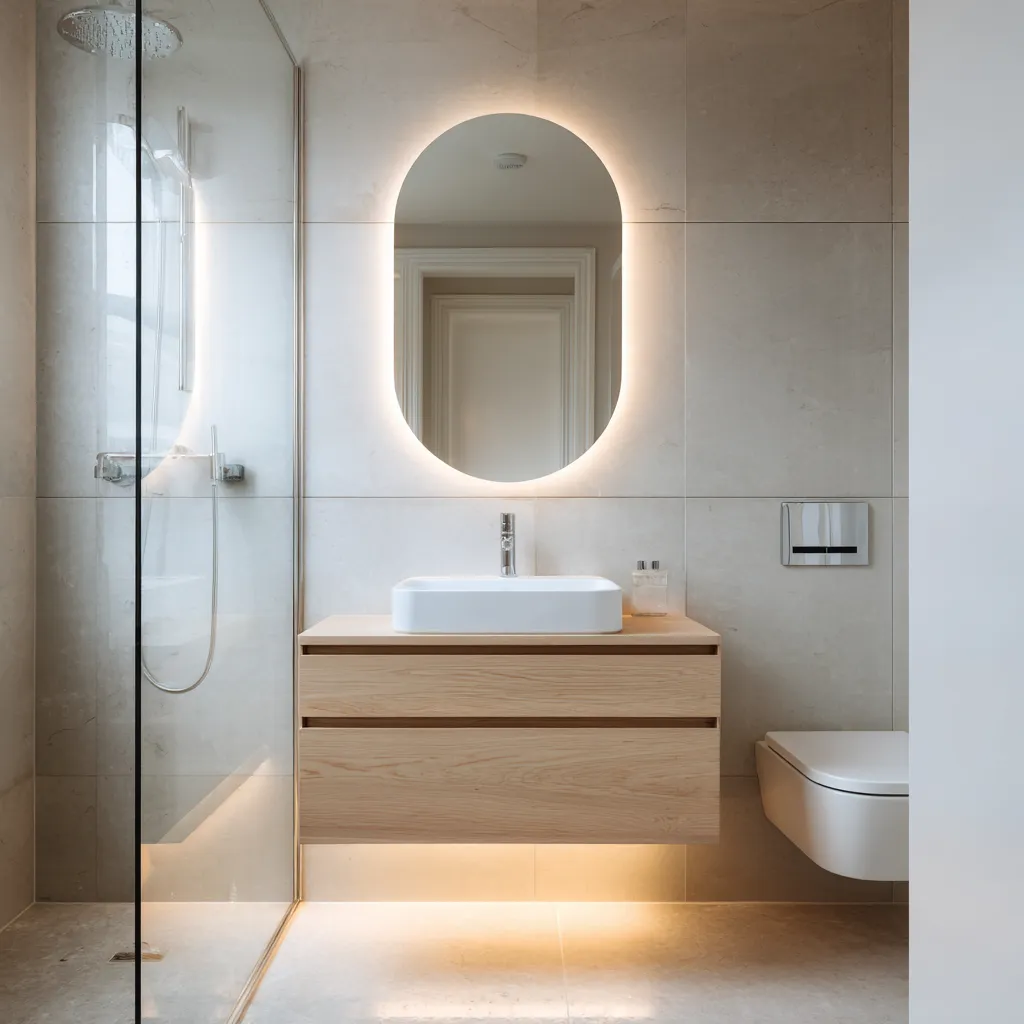
The unglamorous perennials: white sanitaryware (every decade's survivor); stone-and-timber-look surfaces in believable, low-saturation tones — nature's palette doesn't carry a date; chrome, which has outlived every challenger finish since the 1930s (the finishes guide makes the fuller case); generous mirrors; and proportion itself — a well-laid-out room with respected clearances reads as considered in any era, which is half of what "timeless" ever meant.
The Layer Strategy
The structural defence: sort every choice by replacement cost. Built-in layer (panels, floor, sanitaryware, layout — expensive to change): timeless choices only. Swappable layer (paint, towels, accessories, lighting trim, even brassware at a push): trend freely — this is where sage green and fluted glass belong, at weekend-project stakes. A bathroom with neutral bones and fashionable accessories updates for £200 a decade; one with fashionable bones updates for £5,000. Same rooms, same joy, different clocks.
The Three-Question Test
Before committing anything to the built-in layer: Would this have looked at home ten years ago? (If no — it's a trend; swappable layer.) Am I seeing it everywhere right now? (If yes — the saturation clock is running.) Do I love it, or recognise it? — the killer question; recognition is the algorithm's taste wearing yours. Two fails: enjoy it in towels, not panels.
Designing for Your Actual Timeline
Nuance the internet skips: dating only matters over the horizon you'll own it. Selling within five years? Current-but-neutral shows best (the value guide logic). Forever home? Your love outranks the trend cycle — an adored bold room beats a joyless timeless one, and you're allowed to know that. Renting it out? Neutral bones, always (the rental spec). We'll design honestly for whichever horizon is yours — that conversation is what the home visit is for.
Related reading: 2026 design trends, Tap finishes compared, Bathrooms and resale value, Matt vs gloss finishes.
Not sure which way to go in your own bathroom? Call 01236 801802 — a five-minute conversation usually settles it.